
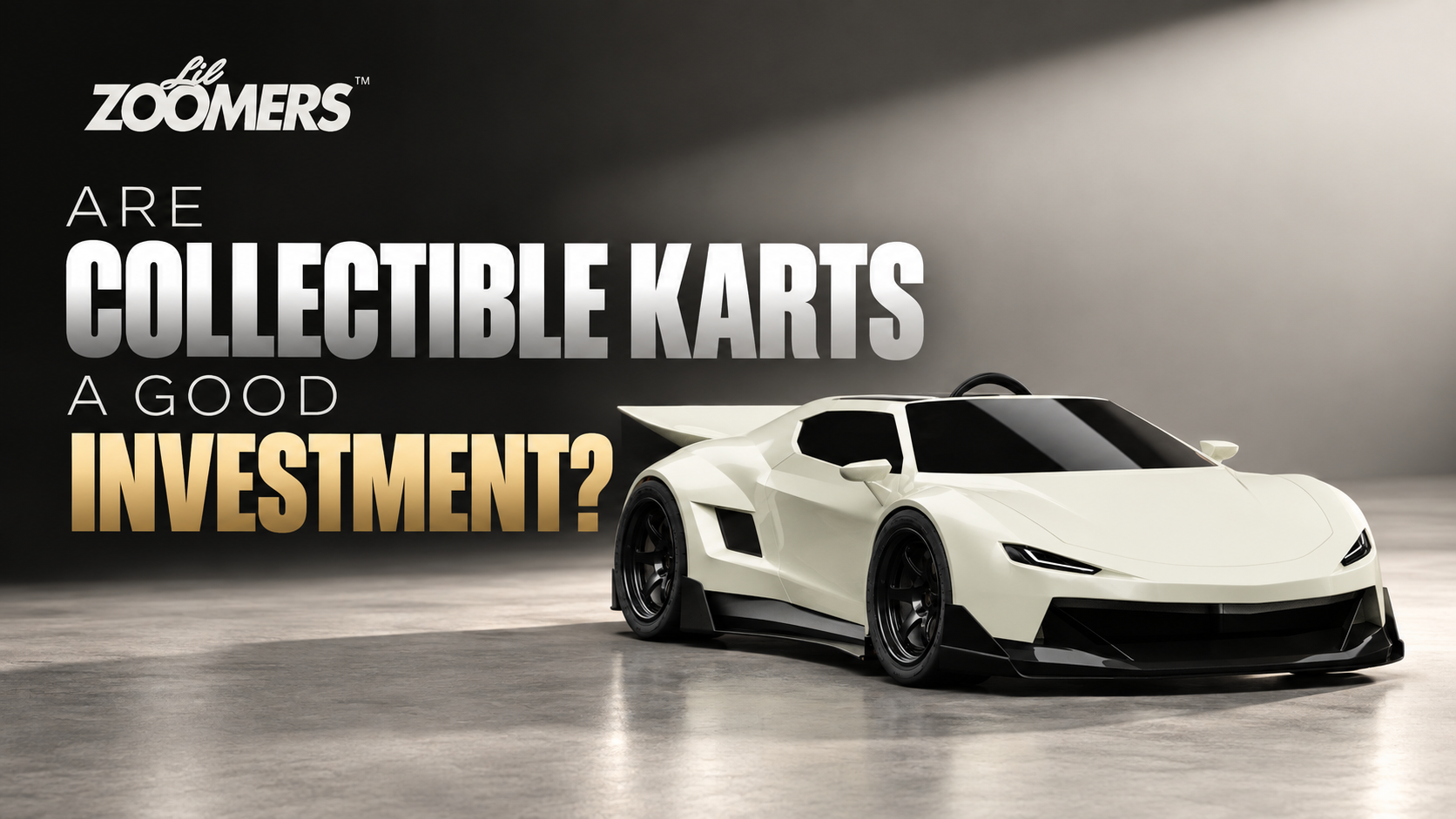
Collectible karts can be a good investment, but only the right ones, bought for the right reasons.
A kart with a clear history,
a limited production run,
and real engineering
behind it can hold its value and sometimes grow it. A mass-produced kart with no story behind it will usually lose value the moment it leaves the showroom, just like most new cars.
The honest way to look at it is this: collectible karts are a passion asset first and a financial asset second.
Think of them the way serious car people think about a classic sports car. You buy one because you love it, you look after it properly, and if the market moves in your favor, that is a bonus.
People who buy collectible karts purely to flip them often end up disappointed, because this is a small market where buyers are picky and patient.
The pieces that do well share a few common traits, and knowing them is most of the battle.
What Makes a Collectible Kart Hold Its Value?
A kart holds its value when it is scarce, well documented, well engineered, and well kept. Here are the factors that matter most when you are judging whether a kart is worth buying as a long-term piece.
1. A small, fixed production run.
Scarcity is the single biggest driver of value. A kart made in a numbered series that will never be repeated has a built-in ceiling on supply, and that is what keeps demand meaningful over time.
2. A clear chassis number and paperwork.
Provenance means the documented history of who made it and who has owned it. A kart with a traceable chassis number and clean records is far easier to sell and far easier to trust.
3. Real engineering, not just looks.
Buyers who know karts look underneath the bodywork. Proper suspension, a stiff frame, and quality parts tell you the kart was built to be driven, and that kind of substance ages much better than styling alone.
4. Original condition.
Collectors pay more for karts that are close to how they left the factory. Heavy modifications, swapped parts, or cheap repairs usually pull the value down, even if they made the kart quicker at the time.
- A brand with a story. Karts tied to a respected maker, a racing era, or a design point of view carry more weight. People are buying the story as much as the machine.
- Careful storage and upkeep. A kart kept dry, clean, and serviced on schedule holds value. One left in a damp shed with flat tires and a tired battery does not, no matter how rare it started out.
If a kart ticks four or five of these boxes, it has a real shot at holding its worth. If it only ticks one, you are buying a toy, not an asset.
Vintage Karts vs New Limited Runs: Which Is the Smarter Buy?
New limited runs are usually the smarter buy for most collectors, because you know exactly what you are getting and you are first in line for the provenance. Vintage karts can be wonderful, but they carry more unknowns.
The Case for Vintage
Older karts from the early days of the sport have charm and history that new machines cannot copy. Some became valuable almost by accident, because few survived and fewer were kept in good shape. The catch is that finding one with honest paperwork is hard, parts can be scarce, and restoration bills add up fast.
The Case for a New Numbered Series
A new kart made in a small, numbered series gives you something vintage often cannot: a clean history from day one. You are the first owner, the chassis number is on record, and the build quality is modern. That is why many buyers who want a premium go kart with collector appeal now look at new limited runs rather than chasing old barn finds. The value is not left to chance. It is designed from the start.
A racing go kart built for competition is a different thing again. Race karts are tools. They get crashed, rebuilt, and updated every season, so very few keep their original parts. That makes them great fun but usually weak investments, unless they carry a famous name or a notable race history.
Where LIL ZOOMERS Fits Into the Collector Conversation
LIL ZOOMERS fits the collector market because it was set up the way collectors actually think: numbered, engineered, and limited from the beginning. It makes electric karts built by car enthusiasts, for collectors, and the whole approach is about ownership and provenance rather than volume.
The flagship is the GENOS R1, with the first chassis carrying the number R1·001. Each kart is commissioned, not configured off a shelf, and there is one owner per chassis number. Karts are allocated rather than stocked, and reservations are by approval only. That process matters for value, because it keeps the owner pool small and the history of every chassis clear.
The engineering is where the GENOS R1 separates itself from a typical kart. It uses a full vehicle architecture, with double wishbone suspension front and rear. Double wishbone simply means each wheel is held by two arms, one above the other, which keeps the tire flat on the ground as the kart moves and rolls. There is adjustable coilover damping at every corner, so the spring and shock absorber can be tuned to the driver and the surface. It carries a 650 lb load capacity at a 185 kg curb weight, which is the weight of the kart with no one in it. Every unit is manufactured and engineered to the same standard.
The whole run was a limited series of 20 units, and those chassis numbers are nearly all spoken for. If a place in the series matters to you, the honest advice is not to wait on it.
What Risks Should Collectors Watch Out For?
The main risks are overpaying, poor upkeep, and a thin resale market. Collectible karts are not a stock you can sell in a click, so it pays to go in with clear eyes.
First, whether you own a premium go kart or a racing go kart, resale takes time. The pool of serious buyers is small, and the right one may take months to find. Second, conditions can slip quietly. Batteries, seals, and tires all age, even when a kart sits still, so neglect eats value faster than most people expect. Third, hype can push prices above what a kart is really worth. If a seller leans hard on urgency but cannot show paperwork, walk away.
Finally, remember that any collectible can go out of fashion. The best protection is to buy something you would be happy to own and drive even if its value stayed flat for years.
Frequently Asked Questions
Do collectible karts go up in value?
Some collectible karts go up in value, but most do not. The ones that rise tend to be from small, numbered production runs with clear paperwork and original condition. Mass-produced karts usually lose value over time, much like a regular new car.
Is an electric kart a better collectible than a petrol one?
An electric kart can be a strong collectible if it is well engineered and made in a limited run. Electric karts are cleaner, quieter, and easier to store and maintain. Value still comes down to scarcity, build quality, and provenance, not the power source alone.
How should I store a collectible kart?
Keep a collectible kart indoors in a dry, stable space, away from damp and direct sun. Follow the maker's service schedule, keep the battery or fuel system cared for, and check the tyres regularly. Save every receipt and service record, because that paperwork adds real value when you sell.
How to Approach Your First Collectible Kart
The best way to approach your first collectible kart is to buy for love and protect for value. Pick something you are excited to own, check it against the factors that drive worth, and keep every piece of paperwork from day one.
Ask hard questions before you buy. How many were made? Is the chassis number on record? What does the suspension and frame look like underneath? Has it been modified? A good seller will answer all of these without hesitation. A kart that passes those checks gives you the best chance of enjoying it now and still seeing strong value later.
If you want a kart that was planned as a collector's piece from the first chassis onward, take a look at the GENOS R1 at lilzoomers.com. It is a good example of what a numbered, engineered build looks like, and with so few chassis numbers left, it is worth asking about one sooner rather than later.