
What Double Wishbone Suspension Actually Is
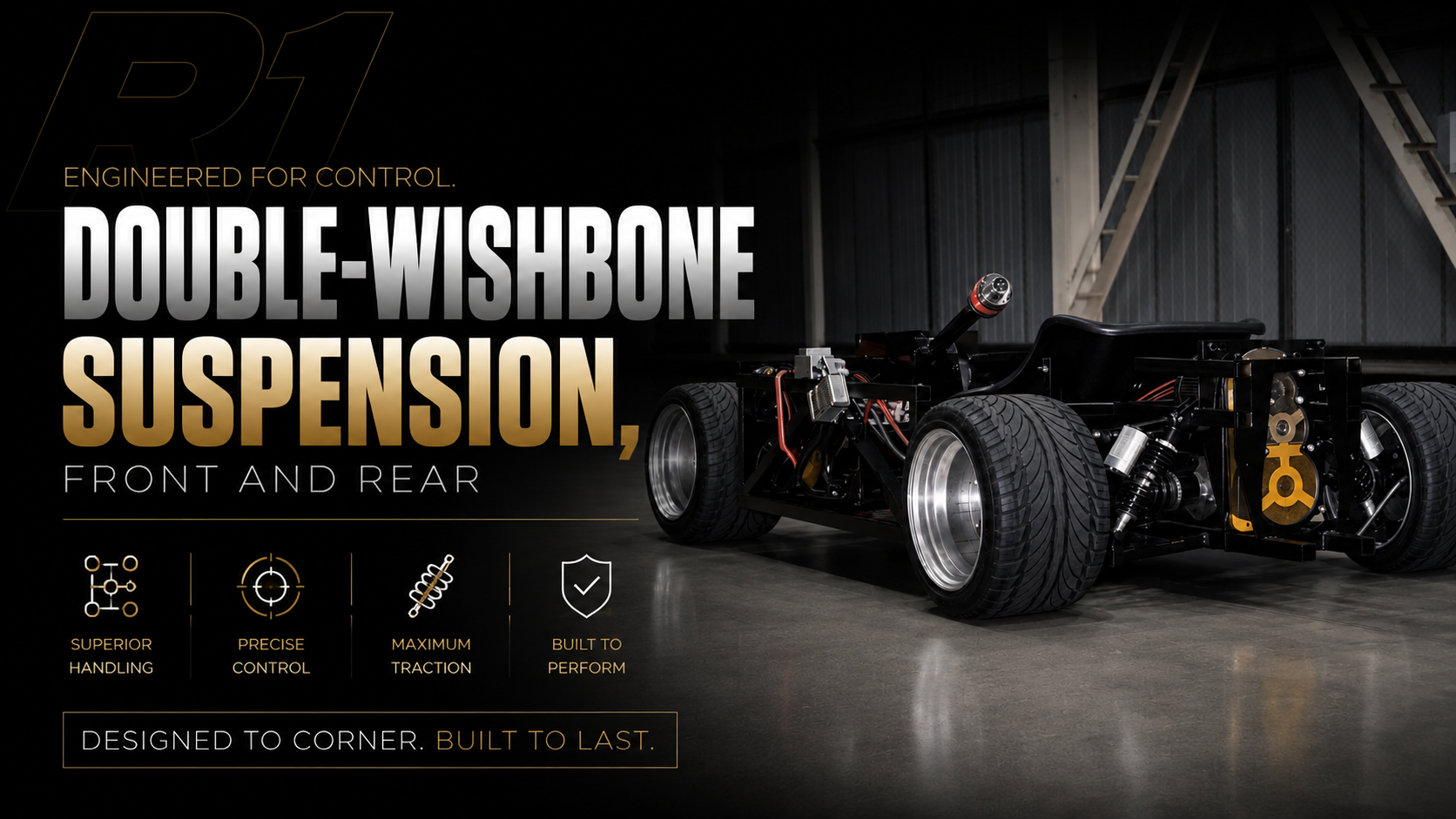
Double wishbone suspension is a setup where each wheel is held by two arms shaped like the letter A, one sitting above the other, that let the wheel move up and down while staying flat against the ground.
When a spec sheet says "front and rear," it simply means all four wheels use this same two-arm design, not just the front pair. The plain reason this is worth caring about is grip. A wheel that stays flat keeps more of its tire touching the road, and more tire on the road is what turns into cornering grip.
The name comes from the shape. Each arm splits into a wide V, a bit like the wishbone in a roast chicken, and there are two of them stacked at every corner. Because the two arms can be sized and angled on their own, the people building the machine get real control over how the wheel leans and how it moves through a bump.
That control is the whole point, and it is why double wishbones show up on serious sports cars and on a proper racing go kart rather than on a cheap runabout.
Why Run It at All Four Corners
You run double wishbones front and rear because a machine is only as composed as its worst corner. If the front end stays flat and planted while the back end flops around on a softer, simpler setup, the car feels nervous the moment you push it. Matching both ends means the front and rear work together instead of fighting each other, and that is what gives a machine a steady, trustworthy feel at speed.
This balance is easiest to notice mid-corner. The front wheels bite and point you where you want to go, and the rear wheels follow cleanly instead of stepping out or dragging wide. On a small, light machine the effect is sharper than on a heavy car, because there is less mass to hide a lazy suspension.
A premium go kart lives or dies on this kind of balance, since the driver sits inches off the ground and feels every shift in grip straight through the seat and the wheel. Get it right at both ends and the whole thing feels like one connected piece rather than a front half towing a reluctant back half.
What a Full Double Wishbone Setup Gives You
The short version is that double wishbones at every corner buy you three things: grip, predictability, and the room to fine-tune how the machine handles. Here is what that breaks down to once you are actually driving.
1. Grip you can feel, not just read.
Because the wheel stays flat through a corner, more of the tire stays pressed into the ground, so the machine holds its line instead of washing wide when you lean on it.
2. Handling that stays predictable.
The setup guides the wheel through the same path every time it moves, so the car responds the way you expect lap after lap. That repeatability is what lets you build real confidence and carry more speed.
3. More even tire wear.
A wheel that stays upright wears across the whole face of the tire instead of chewing one edge, so your rubber lasts longer and keeps its grip more evenly over a session.
4. Camber you can dial in.
Camber is the slight inward lean of a wheel at the top. Double wishbones let a builder set it precisely, so the tire sits flat on the road exactly when you are cornering hardest and loading it most.
5. A planted feel over bumps.
The two arms soak up a rough patch while keeping the wheel square to the ground, so hitting a bump mid-corner does not throw the whole machine off its line.
6. True front-to-rear balance.
With the same quality setup at both ends, the car turns in as a single unit instead of the front and rear each doing their own thing and unsettling each other.
Where Double Wishbones Become the Whole Point
Most of the time good suspension is something you enjoy without ever thinking about it. On a build like the GENOS R1 from LIL ZOOMERS, it is the point. LIL ZOOMERS makes premium electric go-karts, engineered for collectors rather than churned out for a shelf, and the GENOS R1 carries double wishbone suspension front and rear with adjustable coilover damping at every corner.
A coilover is a spring wrapped around a shock in a single unit, and adjustable damping means you can tune how firm or soft each corner feels instead of living with one fixed setting.
That is a different proposition from a basic kart you pull off a pallet.
A machine built around a full wishbone setup, with a proper vehicle architecture holding it all together, behaves like a small serious car rather than a toy. It is the gap between a racing go kart that only goes fast in a straight line and one that actually rewards a clean, committed corner.
The GENOS R1 wears chassis Nº R1·001, and it is manufactured and engineered as one build in a numbered series, allocated to one owner per chassis number by approval rather than sold off a stock list.
The whole run was a limited series of 20 units, and those chassis numbers are nearly all spoken for. If a place in the series matters to you, the honest advice is not to wait on it, because a numbered series does not restock once the numbers are gone.
Frequently Asked Questions
Is double wishbone suspension better than a simpler setup?
For handling, yes. Double wishbones keep the wheel flatter through a corner than most simpler designs, which means more grip and more predictable behavior. The trade is that they use more parts and take more care to build and set up, which is exactly why you find them on sports cars and serious karts rather than budget machines.
What does "front and rear" actually change?
It means both ends of the machine use the same quality suspension, so they behave as a matched pair. When only the front has a proper setup, the rear can feel loose or vague under load. Matching both ends gives you a car that turns in and settles as one piece, which is what makes it feel planted when you carry speed into a corner.
Do I need adjustable damping if I am not racing?
Not strictly, but it helps more than you might expect. Adjustable damping lets you soften the ride for a relaxed session or firm it up for sharper response, all from the same machine. Even for a spirited weekend driver, being able to dial the feel to the day and the surface is a real, everyday gain.
What to Look For in Your Next Build
If you take one thing from all this, let it be that suspension is where a machine wins or loses its feel long before speed ever enters the conversation. A full double wishbone setup front and rear, with damping you can adjust, is the honest sign that a build was designed to handle and not just to move in a straight line. Everything else, the seat, the bodywork, the badge, sits on top of that foundation.
That is exactly the ground LIL ZOOMERS chose to stand on with the GENOS R1. If a numbered, spec-driven build with double wishbones at every corner is the kind of thing you would actually want in your garage, it is worth a look at lilzoomers.com while a few chassis numbers in the series remain.