
Why Electric Karts Became Collectible
Karts used to be simple machines. A small engine, a frame, a seat close to the ground. Then electric versions showed up, quiet, quick off the line, and a little strange to people who grew up around the smell of two-stroke fuel. At first they were seen as toys for kids or training tools for young racers. That changed fast.
A handful of early electric karts were built in small numbers, often as test beds for new battery tech or as showcase pieces at motorsport events. Because so few were made, and because electric karting turned out to be a real sport with its own following, those early models started catching the eye of collectors. The same thing happened decades ago with early production race cars, and even with the first mass market electric bikes. Rarity plus a good story tends to pull people in, and electric karts have both.
There's also a generational angle worth mentioning. The people who raced or watched electric karts in their early, rough around the edges years are now adults with money to spend on nostalgia. That's the same pattern that drove up prices on early video game consoles and first generation mountain bikes. Give it enough time, and yesterday's odd little test unit becomes tomorrow's centerpiece.
What Entry-Level Electric Karts Cost
If you just want a solid electric kart to drive and enjoy, you don't need to spend collector money. Basic recreational models built for backyard use or casual track days generally land in the low thousands of dollars. These are mass produced, easy to service, and not built with rarity in mind. Parts are widely available, and most local shops that handle electric bikes or scooters can service the motor and electronics without much trouble.
Step up to a kart made for real competition, the kind used in junior racing leagues or entry-level electric racing series, and the price climbs. You're paying for a stiffer chassis, a motor tuned for consistent output lap after lap, and a battery pack built to handle repeated hard use without losing power. These competition-grade karts often cost several times more than the casual models, simply because the parts inside them are held to a tighter standard. Manufacturers also tend to back these models with better warranties and more responsive support, since teams racing them can't afford long downtime.
None of this touches collectible territory yet. It just sets the baseline so the jump in the next section makes sense. Think of these two categories as the floor. Everything past this point is priced on story and scarcity, not performance.
What Drives the Price Up
Once you're shopping for a kart that's actually considered collectible, the price stops being about what the kart can do and starts being about what it represents.
1. Battery and Motor Upgrades
Early electric karts often ran on battery packs that look primitive next to what's available now. Collectors care about originality, so a kart with its original pack, even one that no longer holds a full charge, can be worth more than one with a modern replacement. That sounds backward until you remember that collectors are buying history, not just performance. A well documented motor and battery setup, kept in its original state, adds real value on top of the base price of the kart.
This is also where things get tricky for buyers new to the space. A tired original battery pack is a feature to a collector and a problem to a driver. Before you buy, decide which one you actually are, because that changes what a fair price looks like for the exact same kart.
2. Limited Runs and Racing Pedigree
The bigger jump in price comes from limited production and racing history. A kart built in a run of a few dozen units, or one that was actually driven in a notable early electric racing event, can be worth many times more than an identical looking model with no history behind it. Paperwork matters here. A clear record of who owned the kart and where it raced can double the asking price compared to a kart with the same specs but no story to back it up.
Serial numbers and build sheets, when they exist, do a lot of the heavy lifting in these sales. Two karts can roll off the exact same production line and end up worth completely different amounts once one of them picks up a race history and the other doesn't. It's a strange market in that sense. The metal barely changes, but the story attached to it changes everything.
The New Kind of Collectible: Cars Like the GENOS R1
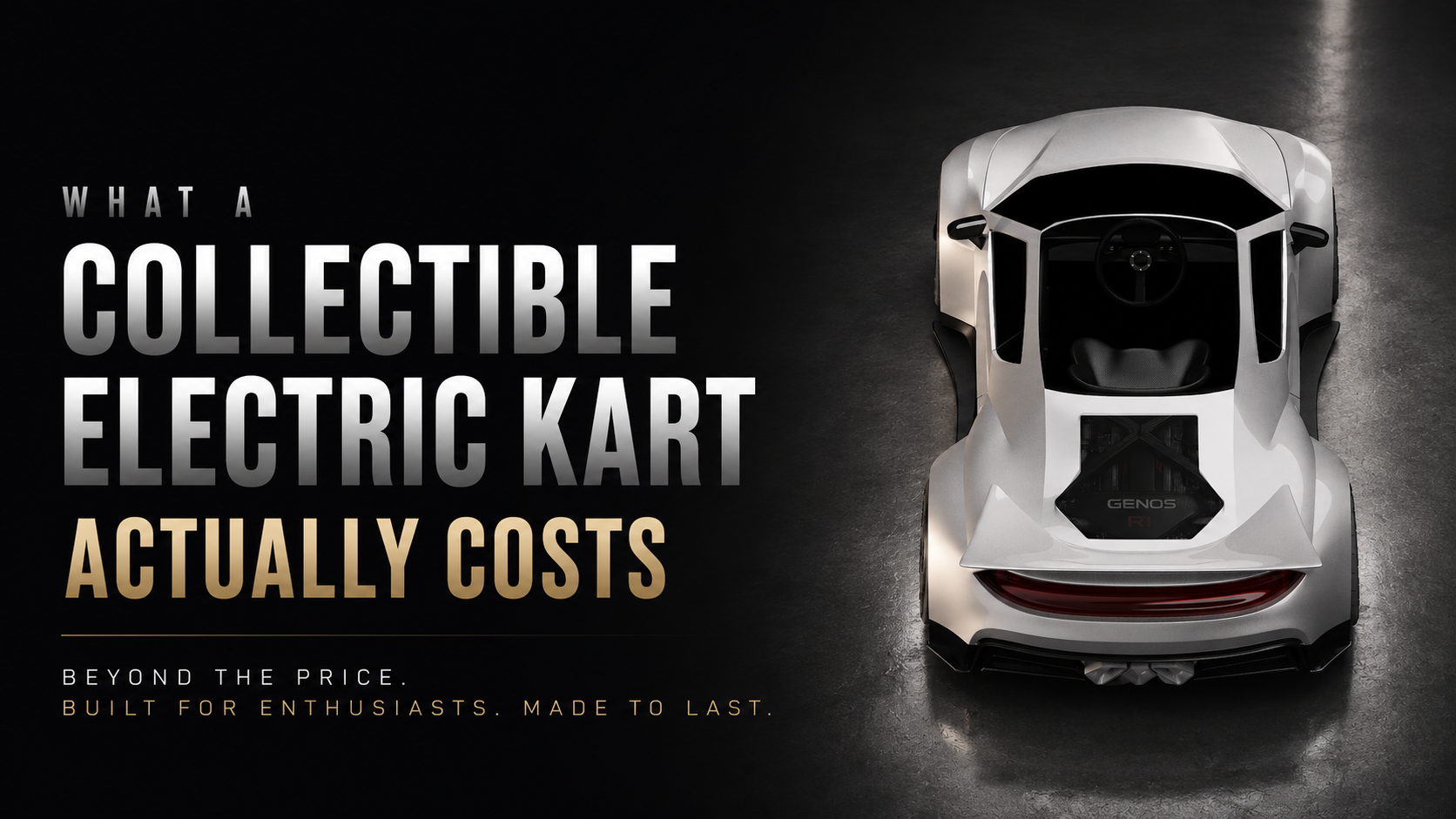
Everything above describes karts that became collectible after the fact, built for one purpose and picked up by collectors years later almost by accident. LIL ZOOMERS builds toward that outcome from the start with the GENOS R1, and it changes how you should think about value.
The R1 is engineered on full vehicle architecture rather than scaled down toy parts, with double wishbone suspension and adjustable coilovers at every corner, the same setup you'd expect on a proper sports car, not a backyard runabout. It carries a 650 pound load rating and is manufactured in a capped series of 20 units, each one engineered to its own chassis number and delivered with a signed build sheet. This is a real production operation behind a small, deliberate run, not a one-off shop project.
That combination, real engineering, a small numbered series, and paperwork tied to the chassis from day one, is exactly what turns a kart into a long term collectible rather than a depreciating toy. The difference is you're not betting on history showing up later. It's engineered from day one.
Where to Buy One Without Overpaying
Specialty auctions are the most transparent place to start, since past sale prices are usually public and give you a real sense of what similar karts have gone for recently. Watching a few auctions before you actually bid is worth the patience. You'll start to notice which details, like an intact original charger or a matching numbers battery, actually move the price and which ones don't.
Motorsport forums and enthusiast clubs are another good source, and often cheaper, since sellers there are usually collectors themselves rather than dealers looking to mark things up. These communities also tend to know the history of specific karts already, which can save you the work of verifying a seller's claims from scratch. If you'd rather skip the guesswork entirely, going straight to a builder like LIL ZOOMERS and commissioning a numbered build removes the uncertainty around history and originality altogether, though it comes with its own waitlist and approval process.
Whichever route you take, ask for the battery's charge cycle history and current health before agreeing on a price. A kart with a tired original battery is still a good buy if the price reflects that, but plenty of sellers price as if the pack were new. Also ask for any paperwork tied to the kart's build number or race history. If a seller can't produce it, treat the rare label with some caution and price the kart closer to a standard model until you can confirm otherwise.
It also helps to have someone who knows electric drivetrains look the kart over before you buy, the same way you'd have a mechanic check a used car. Battery packs can look fine and still be near the end of their useful life, and that's not always obvious from a listing photo. A short test run, even a slow one around a parking lot, tells you more than any spec sheet.
What Your Money Actually Buys
At the end of the day, a collectible electric kart is priced on three things: how few were made, how well documented its history is, and how original its parts remain. Two karts can look nearly identical and sell for very different amounts once you factor those in.
If you're buying to drive and enjoy, stick with the entry-level or competition-grade options and skip the collector premium entirely. You'll get a kart that's easier to service, cheaper to replace parts on, and just as fun on a Saturday afternoon. If you're buying to own a piece of history, whether from electric racing's early days or from a numbered series like the GENOS R1, know that you're paying for the story as much as the machine, and that the story is exactly what will hold its value down the road. Either way, walk in knowing which kind of buyer you are before the bidding starts.
If any of this has you weighing your own first collectible, LIL ZOOMERS is worth a look. Head to lilzoomers.com to see the GENOS R1 and check what's currently open for reservation.