
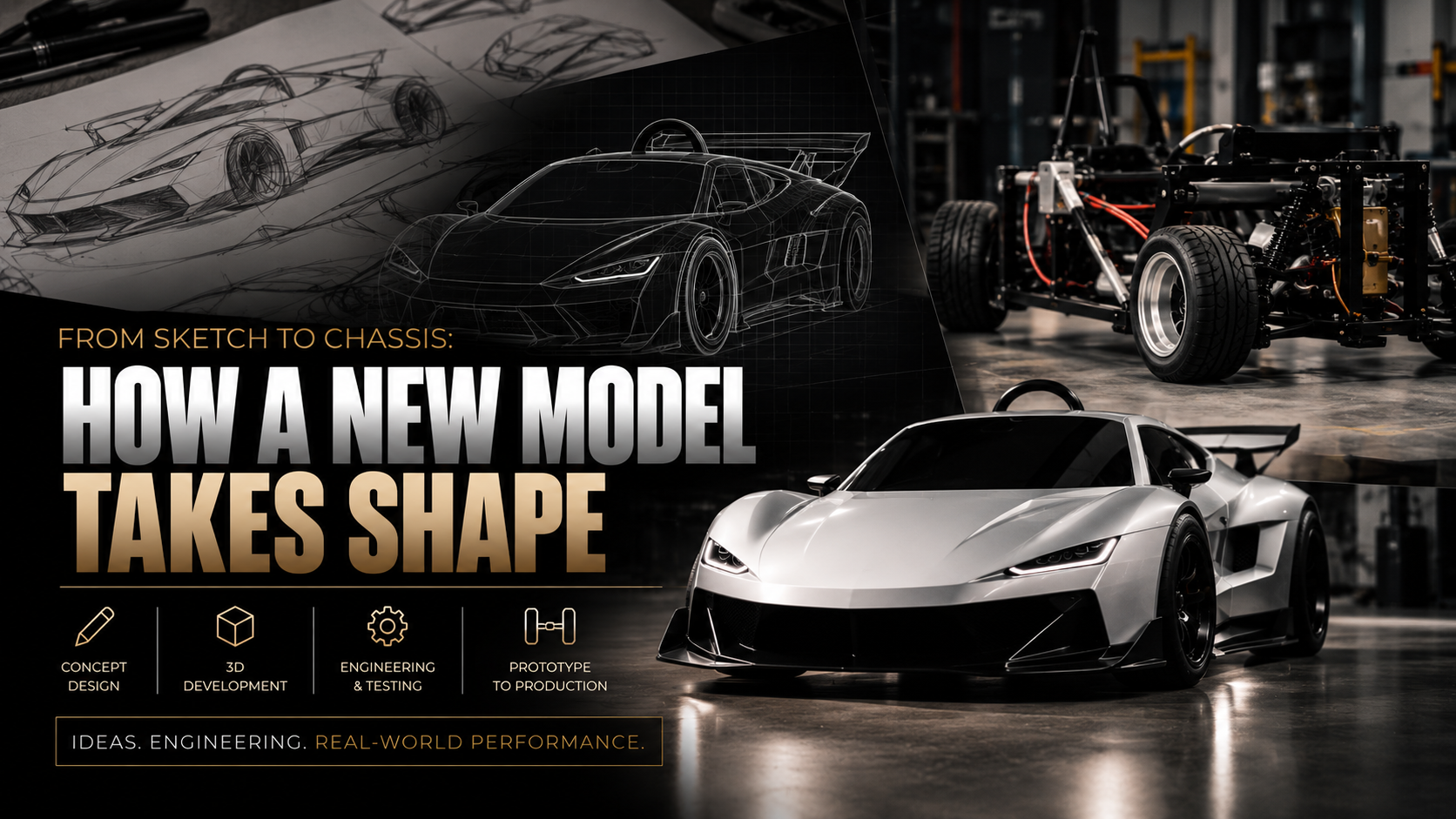
What Happens Before Anyone Draws the Chassis?
Before a single line is drawn, the team decides who the kart is for and what it must do. That decision, often called the design brief, sets the rules for everything that follows: size, weight, how it should feel to drive, and how long it should last. Good kart chassis design starts with that brief, not with a pretty picture.
A kids' starter kart, a racing go kart built for timed laps, and a premium go kart made for collectors all need very different briefs. One chases low cost, one chases lap times, and one chases build quality and long-term ownership. Getting this wrong early is expensive, because every later choice rests on it.
The brief also lists the hard limits.
How much weight must the frame carry?
What kind of ground will it run on?
Who will sit in it, and how tall might they be?
These answers feel boring next to the fun of styling, but they are what keep the finished kart honest.
How Does a Sketch Become an Engineering Plan?
A sketch becomes an engineering plan when every curve on the page is given a real number. The designer's drawing shows the mood and the stance. The engineer's job is to turn that mood into measurements a factory can follow, down to the width of each tube and the angle of each mount.
From Paper to Screen
Most teams move the sketch into CAD, which stands for computer-aided design, meaning software that builds the kart as a precise 3D model. Inside that model, engineers can check whether the seat clears the steering column or whether the body panels leave room for the wheels to turn.
Fixing a clash on a screen costs almost nothing. Fixing it in metal costs weeks.
CAD also lets the team run stress tests before any part exists. The software shows where the frame bends most under load, so the engineers can add strength in the right spots and trim weight where it isn't needed.
Why the Frame Comes First
The chassis, which is the main frame everything bolts onto, is locked in before the bodywork because it decides how the kart behaves. A stiff, well-planned frame keeps the wheels planted and the steering calm. A weak one flexes in corners and feels vague, no matter how good it looks. Styling can be tweaked late in the process. The frame can't.
Seven Steps Every New Kart Model Goes Through
A new kart model usually passes through the same seven stages, whether it is a weekend fun machine or a serious collector piece. The order matters, because each step checks the one before it.
1. Write the brief
Define the driver, the use, and the limits. This is the yardstick every later decision gets measured against.
2. Sketch the concept
Designers explore the look and stance on paper. Dozens of ideas get drawn so that one strong direction can win.
3. Build the digital model
The chosen sketch moves into CAD, where it gets real sizes, real parts, and a first round of virtual stress checks.
4. Engineer the suspension
The team picks how each wheel will move over bumps. This is where choices like double wishbones, meaning two arms per wheel that keep the tire flat on the ground, get settled.
5. Make a prototype
A first physical kart is produced to prove the numbers. It rarely looks finished, and that's fine. Its only job is to reveal problems.
6. Test and adjust
Drivers put miles on the prototype while engineers watch for flex, wear, and odd handling. Parts get revised, and sometimes the kart goes back a step.
7. Sign off for production
Once the design holds up, the drawings are frozen and the factory sets up to manufacture it the same way every time.
Skip any of these and it usually shows up later, either on track or in the owner's garage.
How the GENOS R1 Went From Idea to Numbered Chassis
The GENOS R1 from LIL ZOOMERS is a good example of what happens when the brief is written for collectors from day one. LIL ZOOMERS makes premium electric karts, built by car enthusiasts, for collectors. That brief shaped every step, from the first sketch to the finished frame.
Instead of a basic frame with a seat on top, the GENOS R1 was engineered as a full vehicle architecture. It uses double wishbone suspension front and rear, the same layout found on serious road and race cars. Adjustable coilover damping sits at every corner. A coilover is a spring and shock absorber combined in one unit, and making it adjustable means the ride can be tuned to the driver and the surface. The kart carries a 650 lb load capacity on a 185 kg curb weight, figures that only come from planning the frame properly at the CAD stage.
The way it is sold follows the same thinking. Each GENOS R1 is commissioned, not configured off a shelf, with one owner per chassis number. Karts are allocated, not stocked, and reservations are by approval only. The first chassis carries the number R1·001, and every one after it is manufactured to the same standard.
The whole run was a limited series of 20 units, and those chassis numbers are nearly all spoken for. If a place in the series matters to you, the honest advice is not to wait on it.
Frequently Asked Questions
How long does it take to design a new kart model?
A new kart model typically takes many months, and often more than a year, from brief to production. Most of that time goes into testing and revising the prototype rather than drawing. The more serious the kart, the longer the testing stage tends to run.
What is the most important part of kart chassis design?
The frame's stiffness and geometry matter most, because they decide how the kart handles and how long it lasts. A frame that flexes in the wrong places makes the steering vague and wears parts faster. Everything else, from the seat to the bodywork, is built around it.
Why do premium karts use car-style suspension?
Car-style suspension, like double wishbones and coilovers, lets each wheel move on its own and stay flat on the ground over bumps. That gives more grip, a calmer ride, and room to tune the setup. A simple racing go kart often skips suspension to save weight, but a premium go kart built for varied surfaces and long ownership benefits from it.
What is the difference between a prototype and a production kart?
A prototype is a test kart built to find problems, while a production kart is the final, approved version made the same way every time. Prototypes often look rough and change often. Production karts follow frozen drawings, so each one matches the approved design.
What to Look For in the Next Model You Consider
The best way to judge a new kart is to ask how it was developed, not just how it looks. Ask who the brief was written for, whether the frame was engineered as a full system, and how much real testing it went through. A kart that answers those questions well will usually drive better and hold up longer.
Look closely at the suspension, the load rating, and the curb weight, because these tell you how much thought went into the frame. Then ask how the kart is made and sold. A properly manufactured model with a clear production process is a very different thing from a one-size-fits-all product pulled from a warehouse shelf.
The sketch is where a kart starts, but the chassis is where it proves itself. If you want to see what a collector-first brief looks like when it reaches the finished frame, take a look at the GENOS R1 at lilzoomers.com. It's a clear example of what careful kart chassis design can become.