
What Are Adjustable Coilovers?
Adjustable coilovers are suspension units that combine a spring and a damper in one piece, and let you change how they behave. A damper is the part that controls how fast the spring compresses and rebounds, so the car doesn't bounce like a pogo stick after every bump.
"Coilover" simply means the coil spring sits over the damper.
"Adjustable" means you can tune it, instead of living with whatever the factory picked.
That last word is the whole story. A fixed setup is a compromise someone else made for you, usually aimed at an average driver on an average road. An adjustable one hands that decision back to the person actually driving.
On a road car, that can mean a firmer feel for a weekend drive. On a track, it can mean the difference between a vehicle that fights you and one that flows.
Why Does Tuning Matter More Than Stiffness?
Tuning matters more than stiffness because the right setting depends on the surface, the driver, and the load, and none of those stay the same. A suspension that is simply stiff will feel sharp on smooth tarmac and skittish on a bumpy one. A suspension that can be tuned lets you find the sweet spot for each.
Plenty of enthusiasts assume harder is always faster. It isn't. When a car is too stiff, the tires skip over small bumps instead of staying pressed into the road. Less contact means less grip, and less grip means slower corners. The goal is control, not punishment. A well-tuned car feels calm mid-corner, settles quickly after a curb, and tells you clearly what the tires are doing.
This applies to any small, light, low vehicle as much as to a full-size car.
A racing go kart is a good example. Many traditional karts have no suspension at all and rely on chassis flex, which works on a perfect surface but gets harsh fast on a real one. Once a kart carries proper suspension, the ability to adjust it becomes the thing that separates a toy from a serious machine.
Why Put Adjustment at Every Corner?
Putting adjustable coilovers at every corner lets you balance the vehicle front to rear and side to side, rather than tuning one end and hoping the other keeps up. Each wheel carries a different load at different moments. Under braking the front works harder. Under acceleration the rear does. In a long corner, the outside wheels take most of the weight.
When only one end can be adjusted, you can fix one problem and create another. Soften the front to stop it washing wide, and the rear may start to feel loose. Independent adjustment at all four corners means you can make small, matched changes and keep the whole vehicle in balance. It also lets you account for the driver's weight, which on a small vehicle is a big share of the total.
Six Things That Decide a Good Coilover Setup
A good coilover setup comes down to a handful of separate factors, and getting each one right matters more than chasing any single number.
1. Damping that suits the surface.
Smooth tracks reward firmer damping, while bumpy roads need softer settings so the tires stay in contact. Start in the middle of the range and adjust in small steps.
2. Matched settings side to side.
The left and right sides should usually start identical. Uneven settings make a vehicle pull or behave differently in left and right turns.
3. Front to rear balance.
Use the front and rear settings to tune how the vehicle turns in. A slightly softer front often helps it bite into a corner, while a softer rear can calm a twitchy back end.
4. The weight it actually carries.
Set up for the real load, including the driver. A setup that is perfect for one person can feel wrong for someone much heavier or lighter.
5. Proper suspension geometry underneath.
Coilovers only work as well as the arms holding the wheels. A double wishbone layout, which uses two arms per wheel to keep the tire flat on the ground as it moves, gives the coilover a stable base to do its job.
6. Changes made one at a time.
Adjust a single thing, test it, and note what changed. Moving three settings at once means you never learn which one helped.
How the GENOS R1 Puts This Into Practice
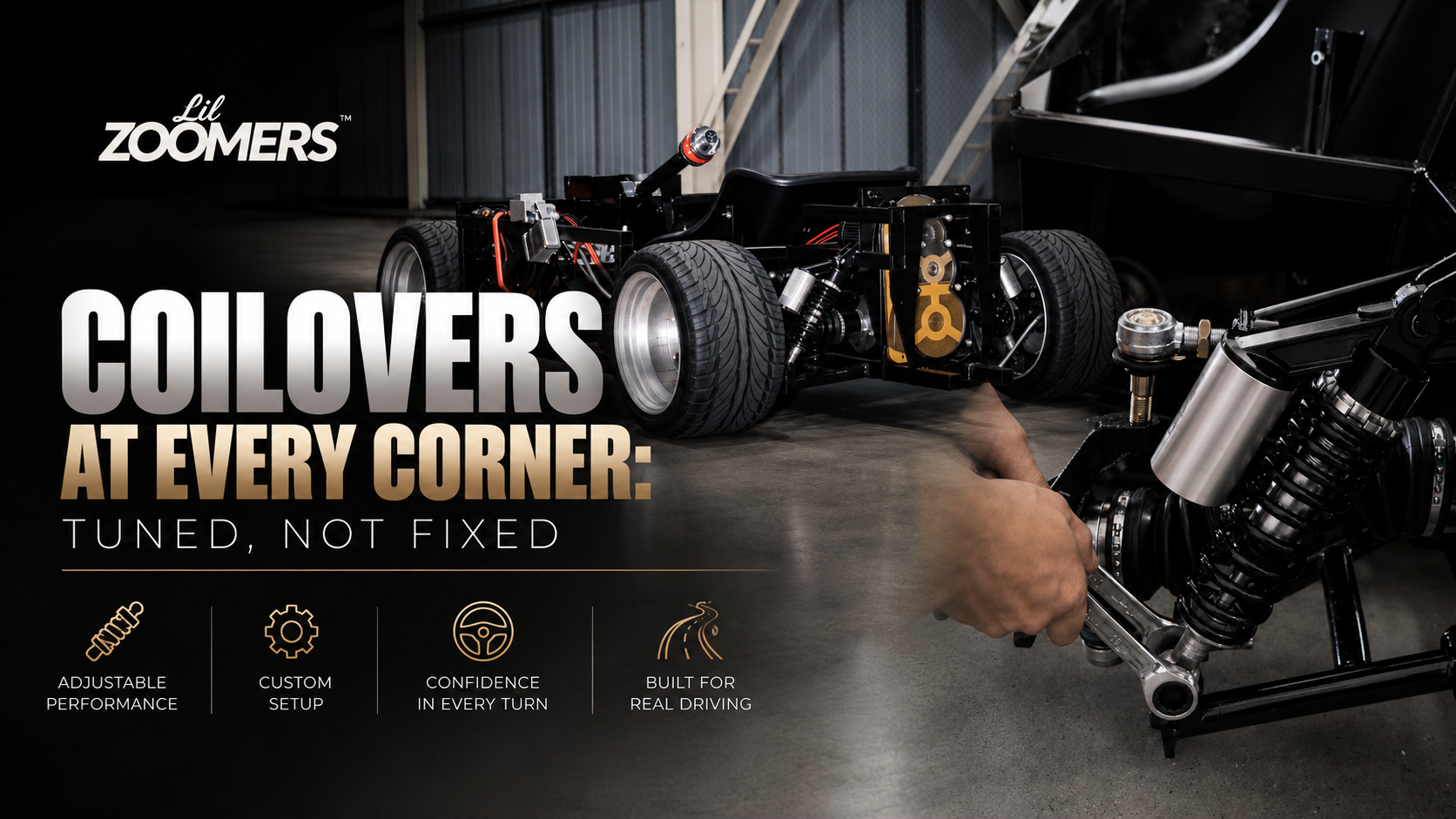
The GENOS R1 from LIL ZOOMERS uses adjustable coilover damping at every corner, paired with double wishbone suspension front and rear. That is the same thinking found on serious performance cars, applied to a vehicle built for collectors. It is engineered as a full vehicle architecture, not a frame with a seat bolted on.
LIL ZOOMERS makes premium electric karts, built by car enthusiasts for collectors, and the suspension is where that background shows most clearly. Where a typical premium go kart might offer a nice finish over basic underpinnings, the GENOS R1 starts with the engineering and builds the experience from there. The numbers that matter are practical ones: a 650 lb load capacity and a 185 kg curb weight, which give the coilovers a known, consistent base to work with.
Each GENOS R1 is manufactured to a numbered chassis, starting with Nº R1·001, and each chassis number has one owner. These karts are commissioned, not configured off a shelf, and they are allocated rather than stocked. Reservations are by approval only. The whole run was a limited series of 20 units, and those chassis numbers are nearly all spoken for. If a place in the series matters to you, the honest advice is not to wait on it.
Frequently Asked Questions
Are adjustable coilovers better than fixed suspension?
Adjustable coilovers are better when the vehicle is used in different conditions or by different drivers, because they can be tuned to suit each one. Fixed suspension can work well for one set of conditions but can't adapt. For anyone who cares about handling, the ability to adjust is worth having.
Do adjustable coilovers make a ride harsher?
Adjustable coilovers don't have to make a ride harsher, since you can set them softer as well as firmer. Harshness usually comes from setting them too stiff for the surface. A sensible middle setting is often more comfortable than a basic fixed setup.
Does a racing go kart need suspension?
Many traditional karts run without suspension and rely on the frame flexing, which works on very smooth tracks. A racing go kart or premium go kart with real suspension handles uneven surfaces far better and keeps the tires in contact with the ground. It also makes the ride more controlled and less tiring over a long session.
How often should coilover settings be changed?
Coilover settings should be changed whenever the surface, the driver, or the load changes in a meaningful way. Once you find a good base setting, most changes are small tweaks rather than big swings. Keep notes so you can return to a setting that worked.
What Tuned, Not Fixed, Means for How You Drive
You notice a suspension setup most when it doesn’t feel right. The rear feels unsettled, a rough section breaks your rhythm, or the kart doesn’t respond quite as you expect. Adjustable coilovers at every corner give you a way to work on that balance and find a setup that suits the surface and how you drive.
Making those adjustments teaches you something, too. Change one setting at a time, drive again, and pay attention to the difference. Over time, you get a better feel for what the kart needs and what you can do behind the wheel. That’s what “tuned, not fixed” comes down to: having room to adjust as your experience grows.
The GENOS R1 brings that approach to a collectible electric kart. Explore the full specifications and request a reservation at lilzoomers.com.