
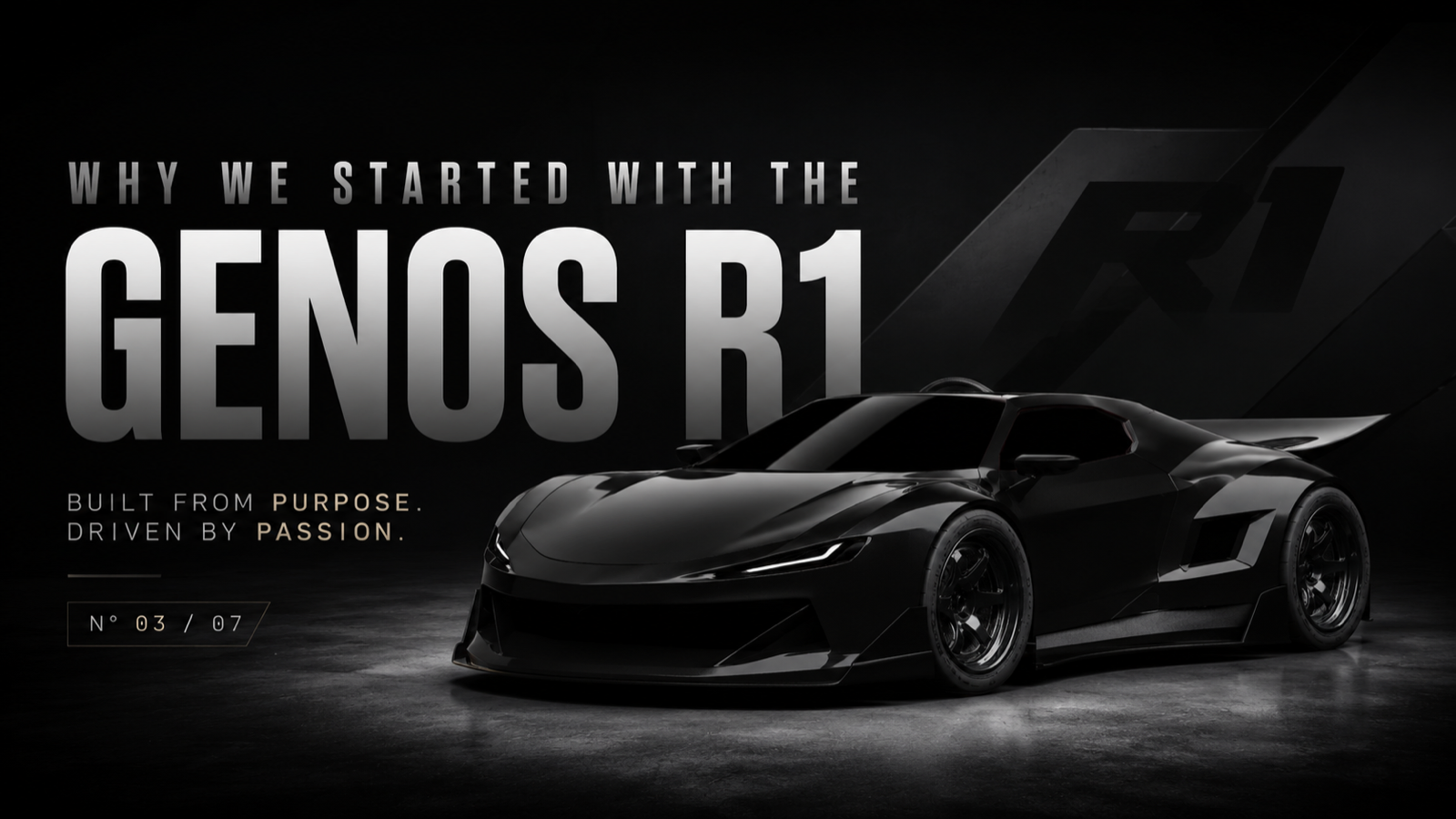
The luxury electric kart market had a problem that was easy to see once you looked for it.
There were products with premium price points. There were machines that looked considered. There were brands presenting themselves as serious alternatives to the kind of driving experience that full-size performance vehicles deliver. But when you examined what was actually being built, the engineering underneath rarely matched the positioning on top. The chassis was simplified. The suspension geometry was basic. The manufacturing process was designed for volume, not for the driver.
No product in this space had been built from first principles, with the discipline that kind of product actually requires.
That gap is what the Genos R1 is the answer to. And understanding why we started there tells you everything about what LIL ZOOMERS is.
What the Kart Market Had
To understand the decision to build the Genos R1, it helps to understand what already existed.
The electric kart market at the time was split between two categories that served two different purposes. On one end were commercial rental fleet machines, built for throughput, durability under heavy use, and ease of maintenance by non-specialist staff. They were not designed around the ownership experience. They were not designed around the driver. They were designed to run back-to-back sessions in a commercial environment and absorb the kind of use that environment demands.
On the other end were consumer products positioned at a premium but engineered to a budget. The price point implied quality. The engineering told a different story. Simplified suspension. Basic braking systems. Chassis geometry carried over from commercial applications, dressed up with bodywork that suggested performance without delivering the architecture behind it.
A serious enthusiast looking for a luxury electric kart at this level had nowhere to go. The choice was between a machine built for commercial use and a machine that cost like a premium product but drove like a compromise.
Neither was acceptable as a starting point.
It is worth being clear about what that gap actually means. A serious adult enthusiast who wants to own, operate, and develop a relationship with a well-engineered electric kart has no product built for them anywhere in the market. Every machine available either belongs to a commercial context or borrows its engineering language from one. The ownership category simply did not exist.
Why a Kart at All
The decision to build a kart rather than another format was deliberate.
The kart format, when engineered correctly, is one of the most communicative driving experiences available. There is minimal mass between the driver and the surface. There is no body roll obscuring what the suspension is doing. Every input translates directly. Every dynamic event is immediate and readable.
That directness is exactly what makes most karts disappointing when the engineering underneath them is simplified. A machine that communicates everything tells you immediately when the geometry is compromised, when the brakes are imprecise, when the suspension is not doing its job. The format is unforgiving of shortcuts.
We did not see that as a problem. We saw it as the point.
If the engineering was done correctly, the kart format would deliver an experience that full-size vehicles, with all their mass management and isolation systems, cannot replicate. The driver would feel everything the chassis is doing. The suspension would communicate through the seat and the steering. The brakes would respond proportionally to input. The machine would reward the driver who pays attention to it.
That is the experience the Genos R1 was built to deliver.
There is also a longer-term dimension to choosing the kart format for a limited-production ownership machine. A well-built kart occupies far less space than any full-size vehicle. It can be stored, transported, and operated in contexts that a full-size car cannot reach: a private circuit, an estate driveway, an enclosed facility. The format fits the ownership context that a serious private enthusiast actually operates in. It is not a machine that requires a racetrack or a license. It requires a space, an intention, and a machine worth taking seriously.
The Standard We Set
Before a single part was designed, we defined what the Genos R1 had to be.
Not fast in a straight line. Not visually impressive at a distance. Engineered correctly, at every point where engineering decisions are made.
That meant a chassis developed through simulation before physical production, with finite element analysis confirming load paths across braking, cornering, and acceleration, followed by real-world track testing to confirm the model. The Genos R1 runs a 4310 chromoly steel chassis, chosen because it delivers the structural integrity the platform requires at a weight the performance architecture demands. Chromoly carries higher tensile strength than mild steel at the same wall thickness, which means the structure can be lighter without being weaker. That matters in a machine where every kilogram affects how the suspension behaves.
It meant double-wishbone suspension at all four corners, because full-vehicle architecture is not a feature that can be approximated without losing what makes it work. It meant hydraulic disc brakes, because the driver's ability to modulate braking pressure through a corner is part of what communicating through a well-engineered machine actually feels like. Mechanical drum or band brakes do not give you that. Hydraulic systems do.
Every drivetrain decision followed the same logic. The brushless electric motor delivers torque linearly and immediately from rest. There is no power band to manage, no lag, no hesitation. The machine responds to input. That response is exactly what the suspension and chassis architecture were built to transmit correctly.
We called this principle scaled, not simplified. It is not a marketing phrase. It is the constraint that governed every decision on the R1. The moment a decision was made to simplify, it violated the premise. So no decision did.
Why 100 Karts and Not More
Production of the Genos R1 is limited to 100 units for this edition.
That number was not chosen for scarcity marketing. It reflects the reality of what it takes to build this way.
Every R1 begins with a design brief. Every unit moves through 3D concept modelling, FDM prototyping, and physical production. Every build is validated before it ships. The process that produces a Genos R1 at this standard cannot be compressed to serve a larger volume without removing the things that make it what it is.
One hundred is the number the process supports without compromise. The machines that come out of it will carry this build designation. Each one is configured to a specific owner's brief. Each one has been through the full process. There are no exceptions made to meet a production target, because the production ceiling was set to prevent that pressure from arising.
That ceiling also means something to the people who own one. The 100 units in this edition are a fixed set. Each is different in its configuration. Each was commissioned by a specific owner and manufactured specifically for them. The production limit is not a constraint imposed on buyers. It is the condition under which the machine can be built correctly.
The 100-unit limit is the design intent made physical.
What LIL ZOOMERS Is Building
The Genos R1 is the first answer to a question LIL ZOOMERS was founded to ask: what does a manufactured, limited-production luxury electric kart actually look like when it is built without compromise?
The answer is an electric hyperkart designed and built in the United States, available in seven approved factory finishes, configurable through a full design brief process that covers paint and livery, interior fabric, forged wheel specification, aero configuration, and drivetrain selection. A machine that arrives fully assembled, validated, and ready for its first session.
It is not the product of an industry that had already figured out how to do this. It is the product of starting from scratch and refusing to simplify. Every decision on the R1 traces back to the same starting point: what does correct engineering actually require at this scale, and what happens when you commit to it without compromise?
The market did not produce this machine because the market was not built to produce it. Rental fleet economics do not lead here. Consumer product margins do not lead here. The only path to the Genos R1 was one that began with the machine rather than the business model.
LIL ZOOMERS was built to walk that path. The R1 is where that work begins. And for the 100 people who commission one, it is the machine that the market should have built a long time ago.
Begin Your Build
If you are ready to discuss configuration, drivetrain selection, delivery, or any aspect of commissioning a Genos R1, the right step is a direct conversation with our team.
The Genos R1 is not intended for road use. Helmet and appropriate safety gear required during operation.