
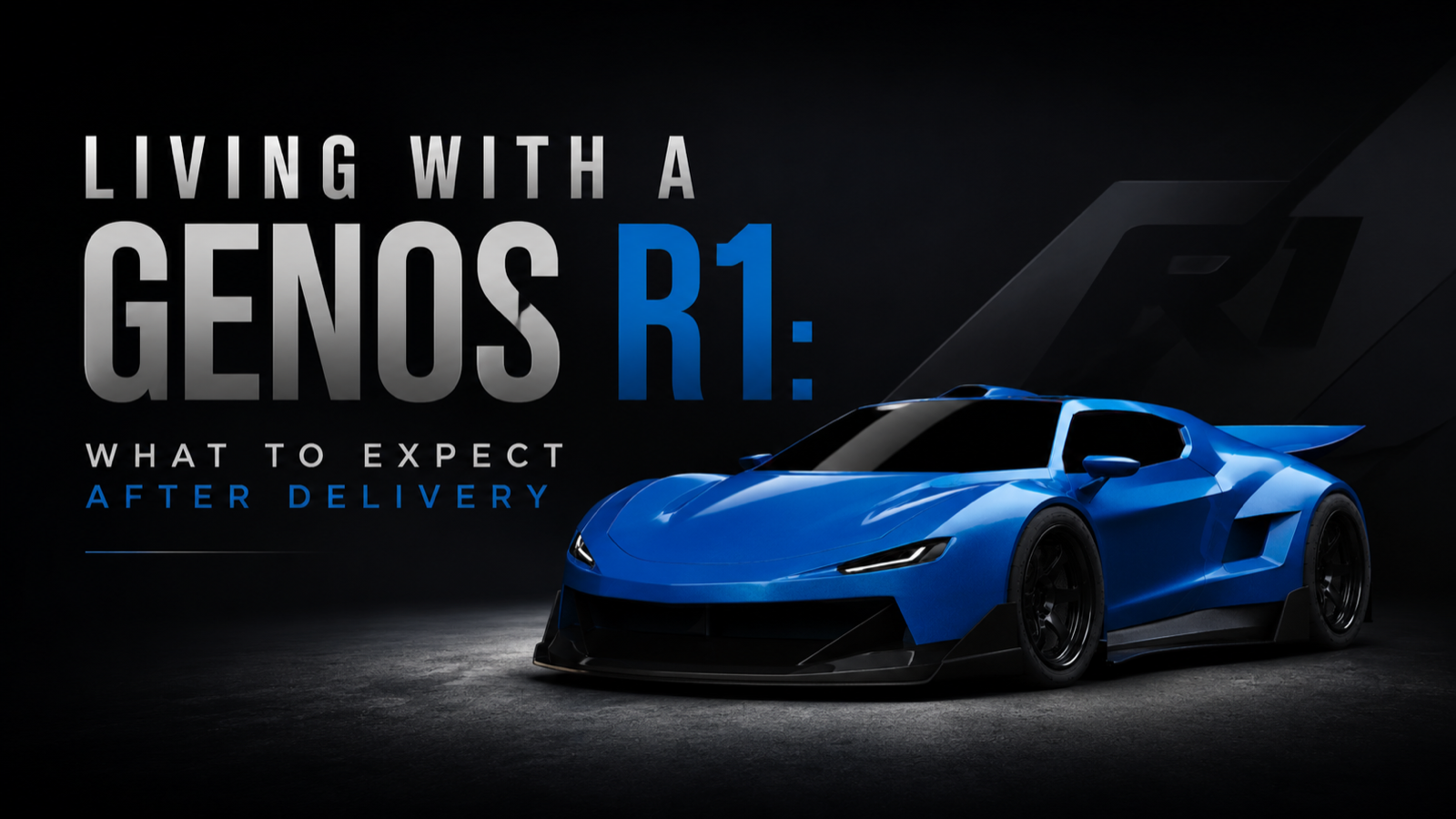
For most people considering an adult electric kart at this level, the product page answers the engineering questions. What they actually want to know is what happens after the crate arrives. What the ownership experience looks like day to day. What routine maintenance actually involves. How charging fits into a normal routine. What long-term life with a machine this purposeful feels like.
This is that post.
What Arrives
The Genos R1 is shipped fully assembled and built to your specification. Because every unit is manufactured to order, what arrives is already your build: your chosen color from the seven approved factory finishes, your interior fabric selection, your wheel specification, your aero configuration.
Before delivery, every unit is validated through the full production process. What arrives is not a flat-pack assembly job or a crate of components requiring mechanical knowledge to bring together. It is a finished, configured machine ready for its first session.
Worldwide delivery is available. Lead time reflects the build-to-order production model, and tracking information is provided once the unit ships. For an international order, customers are responsible for any applicable customs duties or import fees in their country. The LIL ZOOMERS team is available to assist with logistics questions before and during the delivery process.
The First Charge
Before the first session, charge the battery to full. A complete charge takes approximately three hours from empty using a standard home outlet. No dedicated charging station, no commercial infrastructure, no special installation required.
This is one of the practical advantages of electric drive that often goes underappreciated. The R1 charges the same way a phone or a laptop charges, just with a larger pack. You plug it in, leave it, and return to a full battery. No fuel runs, no storage containers, no sourcing petrol for a machine that lives in a private setting.
The first charge is also a good moment to walk around the kart and get familiar with it. Check tire pressure. Review the suspension settings your build was shipped with. Understand what is adjustable and where.
Runtime and Session Planning
A fully charged Genos R1 delivers approximately 2.5 hours of drive time before the battery needs attention. For most private circuit layouts and estate driveways, that is a more than adequate session window.
When the session ends, plug the kart in. Three hours later it is fully charged and ready again. There is no degraded warm-up period, no cold-start routine, no mechanical preparation between sessions. Electric drive means the kart performs consistently from the first session to the hundredth.
For owners who want back-to-back availability, the three-hour recharge window is worth building into session planning. The R1 is designed around meaningful, high-quality sessions rather than continuous all-day operation. Most owners find the rhythm natural within the first week.
It is also worth noting that the R1's electric drivetrain delivers consistent output regardless of how recently the previous session ended. There is no cool-down period, no engine temperature to manage, no residual heat affecting performance in a subsequent run. Plug in, charge, drive. Every session is the same session.
Routine Maintenance: What the R1 Actually Needs
The Genos R1 requires significantly less maintenance than any petrol-powered alternative. There is no engine oil, no fuel system, no carburettor, no ignition components, no exhaust, no air filter. The mechanical complexity that makes petrol karts time-consuming to maintain simply does not exist on the R1.
What does require regular attention:
Battery. Check the state of charge before and after each session. Avoid storing the kart long-term at a very low charge level. Lithium-based packs perform best when they are not regularly fully depleted and left in that state. The motor and battery carry a one-year warranty.
Brakes. The R1 runs hydraulic disc brakes. Inspect the brake fluid level periodically and check pad wear across sessions. Hydraulic systems are low-maintenance but not maintenance-free. Any change in pedal feel is worth investigating before the next session.
Tires. Check pressure before each session. Correct tire pressure directly affects how the double-wishbone suspension performs. A kart with correctly pressured tires and a kart with soft tires are not the same machine, and the difference is noticeable through corners.
Suspension settings. The coilovers are adjustable and hold their position between sessions. If the kart is shared between drivers of different weights or preferences, a brief review of ride height and damping before switching drivers is good practice.
None of this is time-intensive. An owner comfortable with basic vehicle care will find the R1's maintenance requirements genuinely low. A pre-session check takes minutes.
Storage
The Genos R1 is best stored indoors, away from direct moisture and prolonged exposure to temperature extremes. A garage, workshop, or dedicated storage space keeps the paintwork and electrical components in optimal condition between sessions.
At 185 kg, the kart is a substantial machine. Most owners find a flat hardstanding surface with clear access and proximity to a charging outlet the most practical setup.
For owners keeping the R1 as a long-term collectible, the same care principles that apply to any precision vehicle apply here. Keep it covered when not in use. Maintain correct tire pressure even during storage periods. If the kart will sit unused for an extended period, charge the battery to a stable mid-level state rather than leaving it fully depleted or fully charged.
Your Build, Your Ongoing Setup
One of the distinctions of Genos R1 ownership is that the machine was configured around you from the first design brief. The color, the interior, the wheels, the aero: those choices are fixed to your unit. They are yours.
What is not fixed is the suspension setup. The double-wishbone geometry and tunable coilovers are intended to be dialled in over time. As you develop a feel for the kart on your specific surface, small adjustments to damping and ride height will sharpen the driving experience. This is part of what owning a properly engineered machine actually means. The setup is yours to find.
For further customization questions or support on configuration options, the LIL ZOOMERS team is reachable directly through the contact page.
Warranty and Support
The Genos R1 carries a one-year warranty on the electric motor and battery. For any questions or issues after delivery, contact the LIL ZOOMERS team at hello@lilzoomers.com with your order details. The team handles everything from configuration support to post-delivery questions.
The 14-day cancellation window applies from the order date, before production begins. Once production opens on a unit, the build is committed. This is the nature of a manufactured-to-order platform where each configuration is a specific, engineered result.
The Long-Term Experience
Owning a Genos R1 is not the same as owning a product off a shelf. It is closer to owning a vehicle, in the sense that it has a setup, a maintenance rhythm, and a way of rewarding the driver who pays attention to it.
The suspension improves as you dial it in over sessions. The charging rhythm becomes second nature. The R1 settles into the routine of a private property the way a well-chosen vehicle does: something used with intention, maintained properly, and held because it earns its place.
The Genos R1 is not intended for road use. Helmet and appropriate safety gear required during operation.