
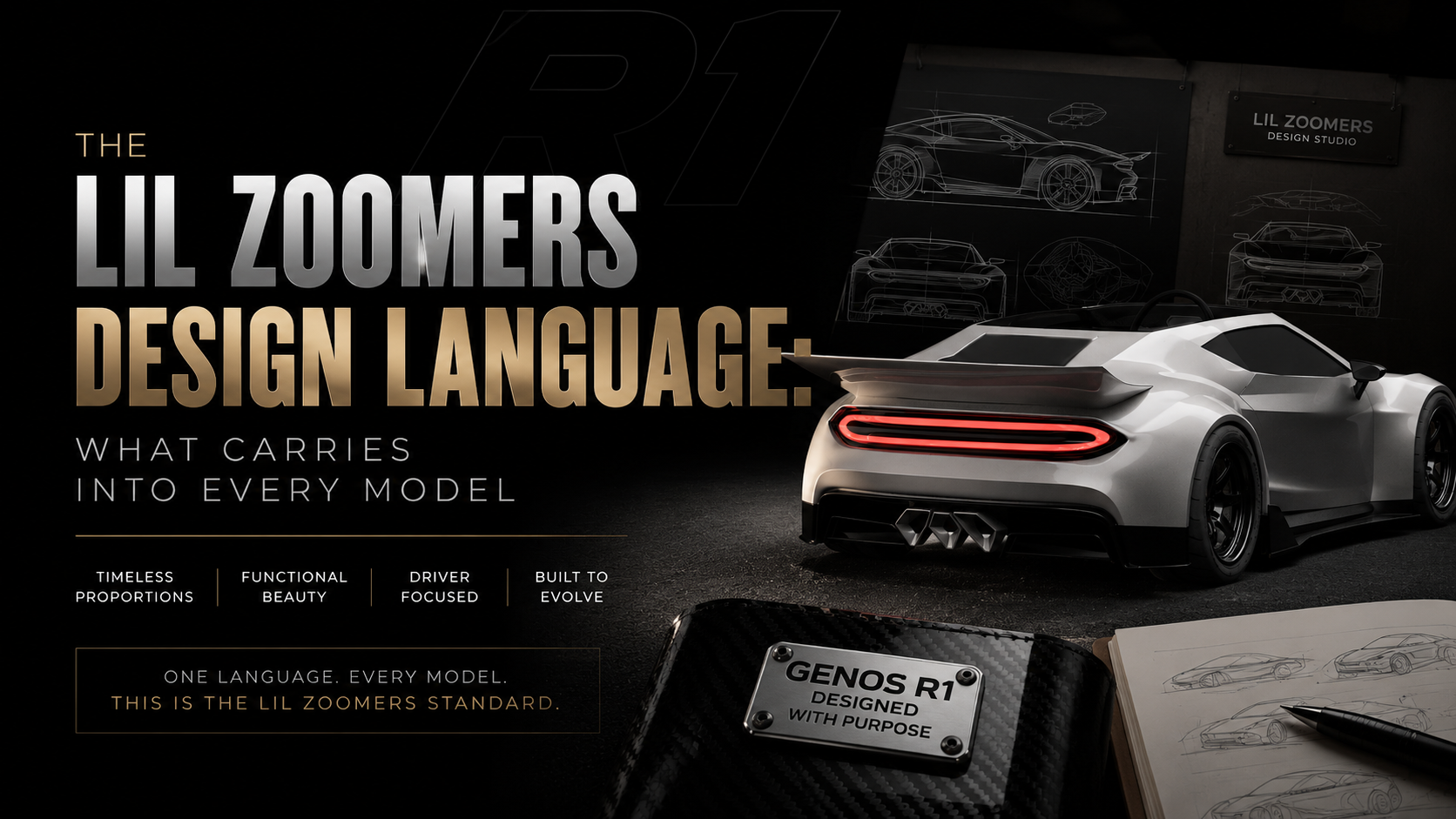
Every serious car brand has a set of ideas it refuses to give up. You can see it across the whole lineup, from the smallest model to the flagship.
A shape of the headlight.
A stance.
A way the doors shut.
That thread running through everything is what people mean when they say "design language." It is not just how a thing looks. It is a promise about how it was built, and what the maker cares about.
If you have shopped for a premium go-kart, you have probably noticed how few of them keep that promise below the surface. LIL ZOOMERS is a young name, but it already has the thread.
The brand builds luxury electric karts for collectors, and its first model, the GENOS R1, sets the rules that everything after it will follow. So it is worth pulling those rules apart and asking a simple question: what actually carries from one LIL ZOOMERS kart into the next?
What "Design Language" Really Means Here
Design language gets thrown around a lot, so let me keep it plain. It is the group of choices a maker repeats on purpose, so that two different models still feel like family. Think of it as a signature. A signature is not one letter. It is the way all the letters lean the same direction.
For some brands the signature is mostly on the surface, a grille shape or a badge. That is fine, but it is skin deep. The LIL ZOOMERS design language sits underneath the paint, in how the kart is engineered before anyone picks a color. That matters, because the parts you cannot see are the parts that decide how the kart drives, holds up, and feels years from now.
Full-Vehicle Thinking, Then Scaled Down
The first idea that carries into every model is the biggest one. LIL ZOOMERS starts with full-vehicle architecture. In normal words, that means the kart is designed the way a real car is designed, with a proper frame and proper geometry, and then scaled to its smaller size. It is not built small and cheap and then dressed up to look serious.
That order of operations is the whole point. Plenty of small electric rides start as a toy and try to add a grown-up look later. LIL ZOOMERS works the other way around. The engineering comes first, and the size comes second. Scaled, not simplified, is the way the brand puts it, and that phrase is a good summary of the entire design language.
Because that thinking is baked in at the start, it will show up in whatever the brand builds next. A second model might look different and carry a different chassis number, but if it wears the LIL ZOOMERS name, it will start from the same place: a real vehicle first, shrunk with care, never faked.
Suspension You Can Feel, Not Just Read About
The next thing that carries over is the suspension setup, and this is where the brand really shows its hand. The GENOS R1 uses double wishbone suspension at the front and the rear. If that term is new to you, here is the plain version. A wishbone is a triangle-shaped arm that holds the wheel to the frame. Using two of them at each corner, a double wishbone, keeps the wheel sitting flat and steady when you turn or hit a bump. It is the same basic idea you would find under a proper racing go-kart, and it is a deliberate choice, not the cheapest one.
On top of that, every corner gets adjustable coilover damping. A coilover is a spring wrapped around a shock absorber. "Adjustable" means the owner can tune how soft or firm it feels, and set the ride height and the way the wheels lean. In driving terms, that is the kind of control you notice mid-corner, when the kart stays planted instead of flopping around. It is the sort of feel most people only expect from a racing go kart built for a track, not from something you can park at home.
Here is why it belongs in the design language and not just the spec sheet. A brand that puts real, adjustable suspension on its first kart has set a bar for itself. Walking that back on the next model would feel wrong, like a watchmaker who starts using plastic gears. Once you promise this much control at every corner, you keep promising it. That is how a signature works. It ties your hands in a good way.
The Numbers That Repeat
A design language also lives in the plain figures a brand keeps hitting. LIL ZOOMERS likes to say it sounds like the build sheet, meaning it would rather show you the measurements than sell you with adjectives. A few of those numbers are worth knowing because they set the shape of the whole thing.
The GENOS R1 carries a 650 pound load capacity, which tells you it is made to be used by grown owners, not just watched. It has a 185 kilogram curb weight, which is the weight of the kart itself before anyone climbs in, and that heft is a sign of real structure underneath rather than thin plastic. These are not flashy stats. They are the quiet kind that separate a real premium go kart from a dressed-up toy, and they hint at how seriously the thing was put together.
The reason to expect these numbers to carry forward is simple. They come straight out of the full-vehicle approach. Build something properly and it weighs something. Build it to be owned and used and it needs to carry real load. Future models will land in the same range for the same reasons, because the underlying method does not change.
One Owner, One Number
There is another part of the LIL ZOOMERS design language that has nothing to do with metal, and it may be the most telling one. The GENOS R1 wears chassis Nº R1·001, and each kart is tied to a single chassis number with one owner. The karts are commissioned, not configured off a shelf. You do not pick options from a website and check out. You scope a build, it is specified to you, and then it is closed to everyone else.
The whole run was a limited series of 20 units, and those chassis numbers are nearly all spoken for. Allocated, not stocked, is the phrase, and reservations are by approval only. That is not a marketing gimmick bolted on at the end. It flows from the same care that shows up in the suspension and the frame.
A brand that engineers each kart this closely was never going to flood a warehouse with them. Scarcity here is stated plainly through the numbered series and the approval step, and that ownership model is as much a part of the design language as any physical part. If a place in the series matters to you, the honest advice is not to wait on it.
You can already see how this carries. Whatever the next model is, expect it to be manufactured in a limited run, tied to chassis numbers, and offered to owners one at a time. The approach to ownership is a signature too.
What Carries Into The Next Kart
Pull it all together and the LIL ZOOMERS design language is easy to describe, even if it is hard to copy. Start with a real vehicle and scale it down instead of cheaping it up. Put honest, adjustable suspension at every corner. Let the plain numbers, the load, the weight, the geometry, do the talking. And treat each kart as a numbered, owned object, not a shelf product. Those four ideas are the thread, and they are what will run through every model that wears the badge.
That is the useful thing about a strong design language. Once you know it, you can predict the brand. You do not need to see the next kart to know what it will believe in, because the beliefs are already set in the first one.
If you want to see where this design language started, the GENOS R1 is the place to look, and you can explore the full build and the reservation process at lilzoomers.com. It is the clearest example of every idea above, sitting in one kart, wearing the number 001, with only a handful of the 20 numbers left to claim.