
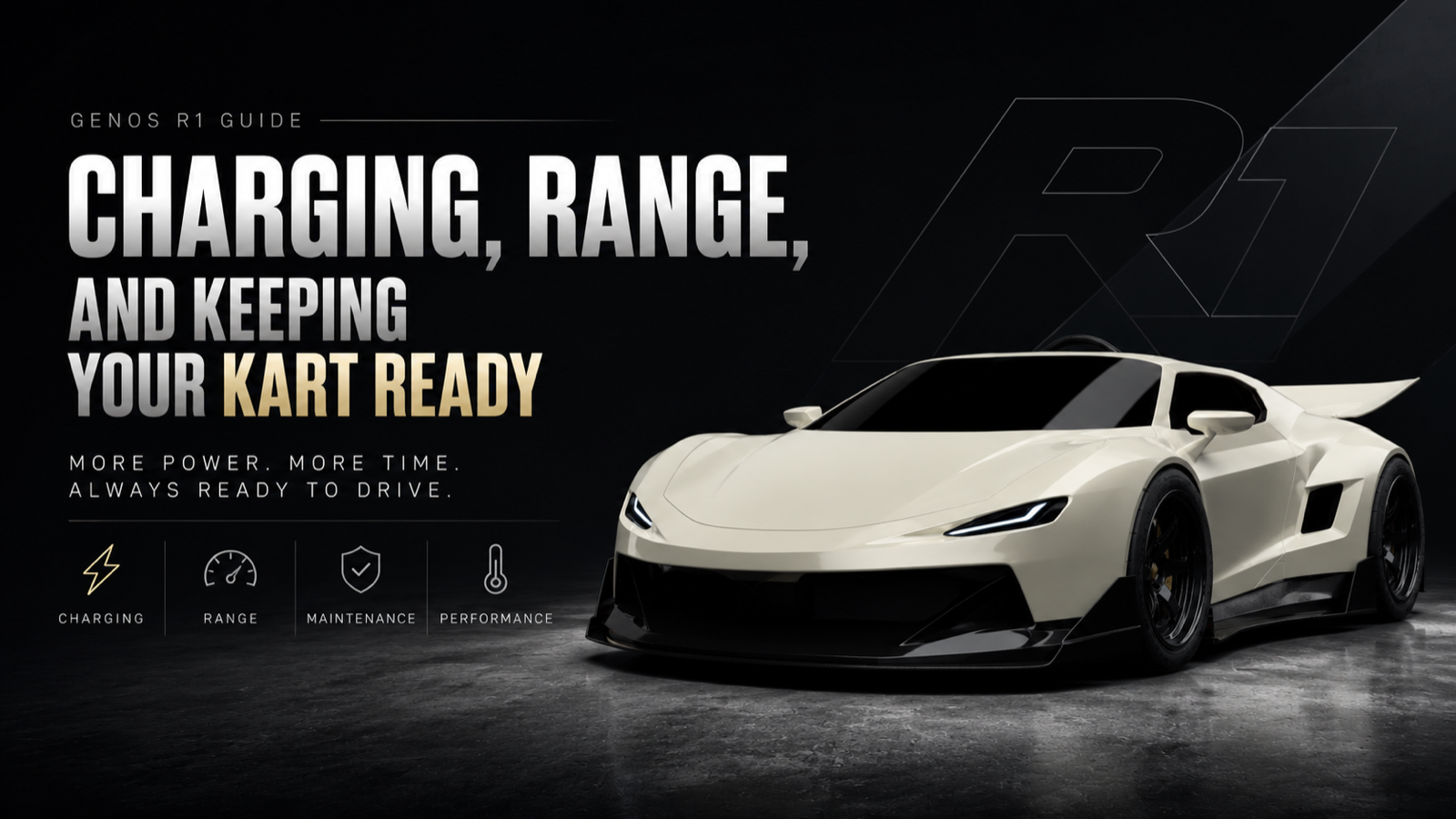
One of the most practical questions a serious buyer asks about an electric kart is not about peak power or top speed. It is about what happens after the session ends.
How long does it take to charge? How many laps does the battery realistically support? What does the machine need between runs to stay in proper condition? These are the questions that determine whether an ownership experience is seamless or frustrating. For the Genos R1, the answers were built into the architecture from the start.
How the Electric Drivetrain Changes the Ownership Model
Owning a luxury electric kart is a fundamentally different experience from owning a petrol-powered machine. The differences are not just technical. They reshape the rhythm of how you use the machine.
A petrol kart requires fuel on hand, an engine that needs warming up before it performs consistently, and a mechanical state that varies with temperature, fuel quality, and the last time it was run. The machine communicates through noise, vibration, and the feel of mechanical components doing their job and sometimes not doing it as well as the session before.
An electric kart has none of those variables. The Genos R1's brushless motor delivers the same torque output from the first meter of the first lap as it does in the final corner of the last. There is no warm-up period to manage. There is no fuel line to bleed or carburetor to tune. The machine is either charged and ready, or it is not.
That clarity is one of the most significant advantages of the platform. Before a session, there is one question: is the battery at the level you need? The answer is always visible. The preparation that goes into a session is about charging discipline and basic checks, not mechanical management.
What the Battery Delivers
The Genos R1 is built around a lithium-ion battery pack engineered for performance density. The pack is designed to support extended on-track sessions at competitive driving intensities, not the short bursts typical of commercial rental fleets.
What this means in practice is that a fully charged Genos R1 will support a meaningful session at a private circuit or estate track without requiring an intermediate charge. The exact range depends on how the machine is driven: an owner pushing the machine hard through every corner at maximum acceleration will draw more from the pack than one running at a measured pace. Track layout, ambient temperature, and gradient all play secondary roles.
The honest framing for any electric kart is that range is not a fixed number. It is a function of how the machine is being used. What the Genos R1 provides is sufficient capacity for the kind of ownership driving it was designed for serious private sessions with enough runtime to develop the machine and develop as a driver.
A useful benchmark is to plan sessions around the battery level you start with. A full charge before each session is the standard. Running the pack to very low levels before recharging is not recommended as a routine practice, since lithium-ion chemistry performs best when cycled within a healthy range rather than depleted completely.
Charging: What the Process Actually Looks Like
The Genos R1 is designed to charge from a standard high-capacity outlet using the supplied charging system. There is no specialist infrastructure required. An owner with a garage or enclosed storage space has everything they need.
Charge time from a significantly depleted pack to full is measured in a few hours. The exact duration depends on the charger specification and the depth of discharge. Owners who build charging into their regular schedule plugging in after each session rather than waiting until the pack is nearly empty will find that the machine is consistently ready without needing to plan around long charge windows.
The charging connection is designed to be straightforward. Plug in, let the system manage the charge cycle, and disconnect when complete. The charging system includes the management electronics to handle this correctly without overcharging the pack.
A practical recommendation for new owners: establish the habit of charging immediately after each session. This keeps the pack in the optimal state-of-charge range for storage, ensures the machine is always ready for the next session, and distributes the charge cycles in the way lithium-ion chemistry handles best.
Between Sessions: What to Check
An electric kart requires significantly less between-session attention than a petrol machine, but it is not zero-maintenance. The Genos R1 rewards the owner who takes a few minutes after each run to go over the machine properly.
The things worth checking after every session are mechanical, not electrical. Tires should be inspected for wear and for any debris picked up on track. The suspension geometry does not require adjustment after every session, but any unusual handling behavior during the run is worth investigating rather than ignoring. The hydraulic braking system should deliver consistent feel; any sponginess or change in pedal response is worth addressing before the next session.
Chassis bolts and suspension fasteners should be checked periodically. A machine driven with intention on a real track will vibrate, and fasteners that are not checked will eventually work loose. This is a five-minute inspection that prevents the kind of problem that stops a session early.
The electric drivetrain itself is lower-maintenance than its petrol equivalent. There is no engine oil to change, no spark plugs to replace, no fuel system to service. The motor and controller are solid-state systems that do not have wear items in the conventional sense. What they do benefit from is keeping the machine clean and ensuring the battery connections remain secure and free of corrosion.
Storage: Getting It Right for the Long Term
For an owner who runs the Genos R1 seasonally or stores it between periods of activity, a few straightforward practices will keep the machine in full working order.
Store the machine at a partial state of charge rather than fully depleted or fully charged. A storage charge of approximately 50 to 60 percent is the standard recommendation for lithium-ion systems kept for extended periods without regular use. This reduces the stress on the cells during storage and protects long-term capacity.
Keep the machine in a dry, covered environment. The Genos R1 is built to be driven, not to live outdoors. A garage or enclosed space protects the chassis, bodywork, and electronics from environmental degradation that has nothing to do with how hard the machine is driven.
If the machine is going to be stored for more than a few weeks, a trickle maintenance charge is worth using if your charger supports it. This keeps the pack from falling into deep discharge, which is the storage condition lithium-ion cells handle worst.
Tire condition should be checked before the first session after any extended storage. Rubber changes with temperature variation over time, and a set of tires that was in good condition at the end of the last season is not guaranteed to perform the same way at the start of the next.
The Ownership Experience This Creates
What the Genos R1's charging and maintenance profile delivers is a machine that stays out of the way between sessions. The time investment required to keep it ready is measured in minutes, not hours. The mechanical unpredictability that characterizes older performance platforms is absent.
This matters because the ownership experience of a serious performance machine should be about the driving, not about managing the machine's mechanical state. The preparation before a session on the Genos R1 is charge the battery, do a quick check of the key mechanical points, and go. The post-session work is plug in, wipe down, and walk away.
That simplicity is not an accident. It is the product of building an electric kart from first principles, with an architecture designed around what a serious private owner actually needs from a machine they intend to use properly and keep in excellent condition over time.
Begin Your Build
Ready to discuss your Genos R1 specification, delivery timeline, or commission details? Connect directly with Lil Zoomers.
The Genos R1 is not intended for road use. Helmet and appropriate safety gear required during operation.